
Why Window & Door Glass Is More Than “Just Glass”
In modern fenestration systems, glass is both a structural envelope (thermal insulation, energy saving, sound insulation, safety) and a daylighting component (transparency, color rendering, aesthetics). Glass accounts for over 60% of a window’s performance, which means selecting the right type is critical.
Key Performance Parameters
•   U-Value (W/m²·K): Heat transfer coefficient. Lower = better insulation.
•   SHGC (Solar Heat Gain Coefficient): Lower = less unwanted heat gain.
•   VT (Visible Transmittance, %): Higher = more daylight.
•   LR (Light Reflectance, %): Affects glare and external appearance.
•   STC / Rw (dB): Sound insulation rating. Higher = quieter.
•   Safety: Breakage pattern, anti-fall, impact resistance.
•   Edge & Surface Quality: Durability, resistance to chips and scratches.
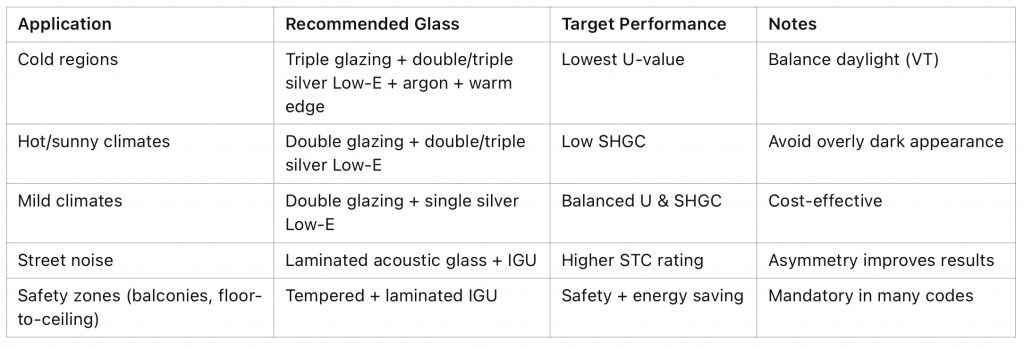
👉 Rule of thumb: Cold climates focus on U-value, hot climates focus on SHGC, noisy areas prioritize STC.
Main Glass Types for Windows & Doors
1.Tempered Glass
•   Strength: 3–5× stronger than annealed glass.
•   Safety: Breaks into blunt particles, reducing injury.
•   Applications: Sliding doors, swing doors, balcony windows, large openings.
•   Note: Must be cut/drilled before tempering.
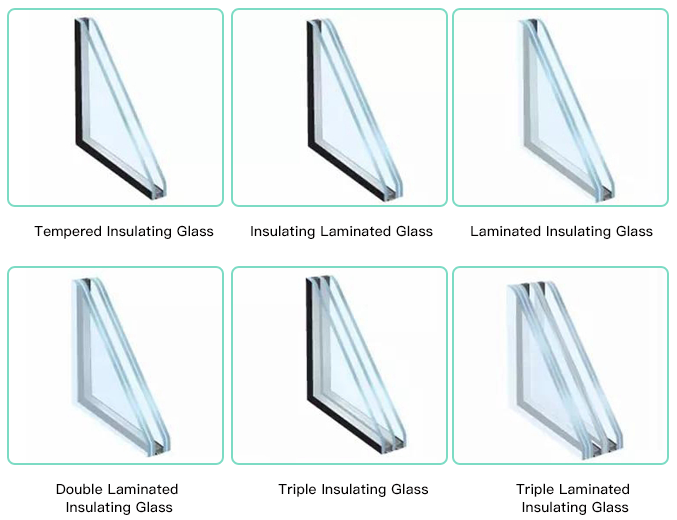
2.Laminated Glass
•   Structure: Two or more panes bonded with PVB/EVA/SGP interlayers.
•   Benefits: Holds together after breakage, prevents falls, improves sound insulation, UV blocking.
•   Applications: Floor-to-ceiling windows, balcony doors, child rooms, street-facing windows.
3.Insulated Glass Unit (IGU)
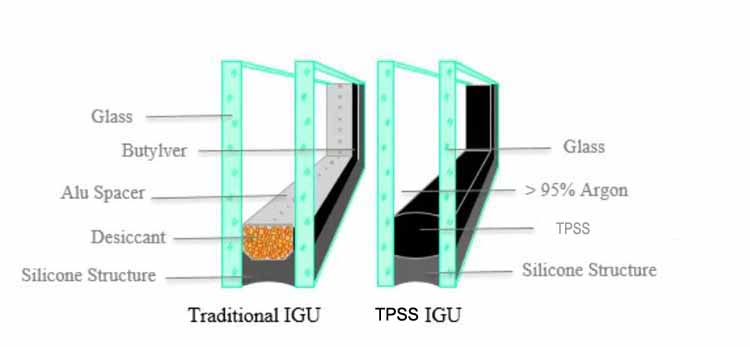
•   Structure: Double or triple glazing with a sealed cavity (air or argon/krypton filled).
•   Benefits: Lower U-value, reduced condensation, improved energy efficiency.
•   Configurations:
•   Double glazing: 5 + 12A + 5 mm
•   Triple glazing: 5 + 12A + 5 + 12A + 5 mm
•   Warm edge spacers: Reduce condensation and thermal bridging.
4.Low-E Coated Glass
• Mechanism: Microscopically thin metallic coatings reflect infrared while allowing visible light.
• Options:
• Single silver: General use, balanced performance.
• Double/Triple silver: Lower SHGC, ideal for hot climates.
• Key detail: Coating position matters (#2, #3, or #5 surface inside IGU).

See also:
•   Tempered Glass Guide
•   Laminated Glass Guide
•   Insulated Glass Guide
•   Deep Processed Glass Overview
Glass Configurations for Different Climates & Applications
Glass Thickness & Weight
• Formula: Weight (kg/m²) ≈ 2.5 × thickness (mm).
• 6 mm ≈ 15 kg/m²; 8 mm ≈ 20 kg/m²; 10 mm ≈ 25 kg/m².
• Example: 5 + 12A + 5 IGU ≈ 25 kg/m² (glass only).
• Doors: Typically ≥8 mm or laminated.
Details That Affect Longevity
- Sealing: Dual-seal IGU (butyl + polysulfide/structural) = more durable.
- Warm edge spacers: Minimize condensation.
- Gas filling: Argon 90% recommended.
- Coating position: Must be correct for Low-E.
- Drainage: Proper window system drainage to avoid moisture intrusion.
- Frame match: Glass thickness must match profile groove depth and hardware strength.
Aesthetic Options
•   Low-iron glass: Clearer edges, less green tint.
•   Tinted glass: Gray, green, bronze for solar control.
•   Reflective coatings: For architectural facades.
•   Anti-glare: Controlled reflection and daylight comfort.
Standards & Certifications
Depending on project region, references include: CE, IGCC, SGCC, AS/NZS, CCC. Always request type test reports and batch inspection certificates when sourcing.

Procurement & Acceptance Checklist
• Glass specification (dimensions, thickness, holes, coating position).
• Target U-value, SHGC, VT, STC.
• Safety requirements (tempered/laminated).
• Spacer & sealant system.
• Factory certificates & test reports.
• Transport & installation guidelines.
Common Mistakes to Avoid
1.  Focusing only on thickness, ignoring IGU performance.
2.  Installing Low-E coatings on the wrong surface.
3.  Using IGU only for noise reduction (laminated is better).
4.  Using 6 mm tempered glass for large door leaves (too weak).
5.  Skipping warm edge spacers, causing condensation.
Recommended Configurations by Budget
• Economy: 6 + 12A + 6 single silver Low-E IGU.
• High performance: 6 + 16A + 6 double/triple silver Low-E + argon + warm edge.
• Acoustic: 8.38 mm laminated acoustic + 12A + 6 Low-E.
• Premium: Triple glazing + triple silver Low-E + krypton gas.
Installation & Maintenance Tips
•   Use soft setting blocks between glass & frame.
•   Uniform glazing pressure.
•   Avoid exposing edges to alkaline/acidic water.
•   Clean with soft cloths; avoid blades on coated surfaces.
Interaction with Window Systems
•   Glass weight impacts hardware selection (hinges, rollers).
•   Profile system (aluminum, uPVC, wood-aluminum) must support glass load and thickness.
•   Always review glass specs at design stage with the supplier.
FAQs
A: More silver layers = lower SHGC, stronger solar control. Triple silver is ideal for hot climates.
A: Not always. Triple glazing = lower U-value but higher cost/weight. Choose based on climate & budget.
A: ≥8 mm tempered or laminated. For large doors, use laminated tempered combinations.
A: Thermal bridging at spacers. Warm edge spacers and humidity control help.
A: Negligible effect on signals. Lighting depends on VT—choose balance between SHGC and VT.
A: IGU is better for energy saving; laminated glass enhances safety and noise control. Best practice: combine laminated + IGU.